Rafo’s homelessness and street life
Cry MachoRafo’s homelessness and street life are both a condition of material deprivation and a way of learning to survive through speed, performance, and mistrust. After leaving home, he sleeps wherever he can find shelter and navigates the city’s alleys, making himself quick and self-reliant; yet his skill at outwitting others cannot resolve the painful attachments and exclusions that follow him there.
Leaving Home and Life in the Alleys
Rafo leaves home after a quarrel with his mother escalates into violence. The conflict follows a pattern of affection and punishment that leaves him ashamed of his resentment and still wanting her love. When he reflects on life in the alleys, he remembers that the early period was miserable, but judges it less painful than remaining at home with those contradictory feelings.
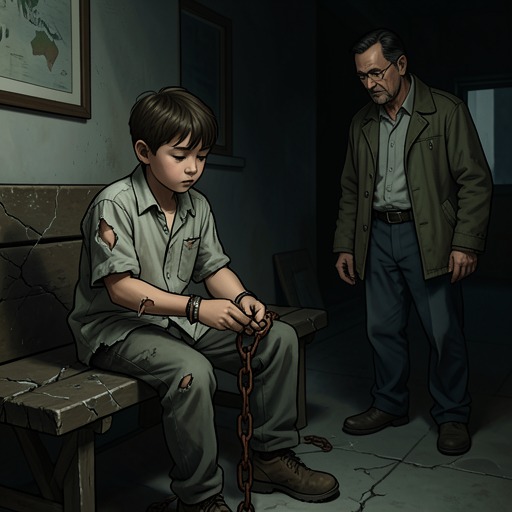
His new life has no stable shelter. He sleeps in an abandoned warehouse, a basement beneath El Picador, or a bus-station toilet, moving from place to place and trying to avoid the police. Food is scarce, and he has to fight for acceptance in a street gang while evading people who threaten to exploit him. His homelessness is therefore not simply a lack of a home: it means constant improvisation under the pressure of hunger, danger, and displacement.
Street Skills and Performance
Rafo presents himself as exceptionally fast and clever. He regards police officers as slow and believes he can handle them if necessary, but avoids taking that risk. He is especially resentful of having lost a fight to Mike, whose strength prevented Rafo from relying on his usual quickness. The encounter unsettles his confidence enough to make him consider whether physical force can defeat the strategy he trusts.
He also turns performance into a means of earning money. Outside the Hilton, he shines shoes for tips, tailoring a story of family hardship to keep a customer listening and increase the payment. He recalls receiving two hundred pesos from one customer and five hundred from a drunk man after pretending to have an injured eye. These episodes show both his inventiveness and the precariousness of a livelihood dependent on persuading strangers to part with small sums.
Although Rafo spoke English very well as a young child, he finds that fluent speech undermines the role of an uneducated, impoverished boy when he tries to con Americans. He deliberately alters his speech into a hybrid register drawing on Mexican, Texan, and street language. What begins as a calculated disguise becomes habitual, and his mother objects to it when he occasionally returns home. The change in his speech records how survival performance has become part of his identity.
Hunger, Shame, and Exclusion
A later confrontation over stolen bananas makes the limits of Rafo’s resourcefulness visible. Hungry and accused of wrongdoing, he insists that he cannot simply behave like a clean, well-dressed schoolboy when he cannot manage to live that way. His explanation is less a defense of theft than an angry account of the gap between the life expected of children and the life he feels able to attain.
He loses control and throws bananas across the grass, gravel, street, and toward the church and school. Some onlookers laugh, others stare, and a few gather the scattered fruit. Once he comes to his senses, humiliation sends him away from the scene. The outburst turns a private grievance into a public spectacle without bringing him help or acceptance.
Afterward, Rafo watches boys playing together from the edge of their group. He appears to try to provoke them, but they do not respond. When they leave at the end of recess, he remains alone by a lamppost, lighting one cigarette from another. The scene echoes the isolation of his life in the alleys: he can approach a possible community, but cannot make himself part of it.
Conflicted Attachments and Significance
Rafo’s account of homelessness is shadowed by his inability to separate hatred from love. He wonders whether he can simply hate either parent, without also wanting to see his father or wanting his mother to love him. The question complicates any simple portrayal of leaving home as liberation: life on the street is harsh, but home has been emotionally painful in a different way.
His street persona—quick, suspicious, verbally adaptable, and proud of surviving—offers practical defenses against hunger and exploitation. It also carries costs. The boy who can manipulate a customer’s expectations cannot readily join other children at play, and the boy who insists that he is more clever than police or strangers remains vulnerable to force and exclusion. Rafo’s homelessness thus shapes not only where he sleeps and how he earns money, but also the guarded performances through which he tries to secure dignity and control.